Choosing thermo hygrometers for a private-label range is not mainly a question of finding the display with the most functions. The real task is to connect the intended environment, measurement evidence, user behavior and production requirements before the sample, packaging and quotation are approved.
This guide provides a practical framework that purchasing, engineering, product, design and quality teams can use in the same RFQ and sample-review process.
Fast screening rule: define the application first, compare measurement evidence second, and approve packaging only after the sample and production criteria agree.
Start with the decision the product must support
Before comparing models, describe what the user will do with the reading. A bedroom user may want quiet visual guidance. A classroom or meeting-room application may prioritize viewing distance and simple interpretation. A storage-area buyer may care more about reviewing maximum and minimum values between inspections.
These examples do not mean that every indoor monitor is suitable for every environment. They show why the application should be defined before features are compared.
Record the expected temperature and humidity conditions, viewing distance, placement surface, hours of operation, alert preference and exposure to direct sunlight, splashes or condensation. Unless supporting evidence says otherwise, an indoor product should not be treated as weatherproof, medical-grade or suitable for industrial-safety decisions.
Compare measurement claims in the correct order
Range, resolution and accuracy answer different questions:
- Range defines the lowest and highest value the product is designed to measure or display.
- Resolution describes the smallest step shown on the screen.
- Accuracy describes how close a reading is expected to be to a reference under stated conditions.
A display that changes in 0.1°C steps is not automatically accurate to ±0.1°C. Accuracy may also differ across temperature or humidity bands. A useful supplier comparison therefore keeps each claim together with its applicable range and test condition.
| Evidence to request | Procurement question it should answer |
|---|---|
| Temperature and humidity ranges | Do the stated limits cover the intended environment? |
| Display resolution | How finely will the screen value change? |
| Accuracy by range or band | Where does each stated tolerance apply? |
| Test condition and reference method | Under what conditions was the claim checked? |
| Update or response behavior | How quickly should the displayed reading react? |
| Current specification, manual and inspection criteria | Do the customer-facing and production documents agree? |
If the product page, manual and inspection criteria use different wording, resolve the difference before approving packaging or sales copy. Choosing the most attractive number is not a substitute for resolving the source documents.
Turn user behavior into product requirements
After the measurement evidence is understood, define how users should read and respond to changing conditions.
Questions worth confirming include:
- Which values must appear at the same time?
- Is a comfort or condition indicator useful for the intended user?
- Should maximum and minimum records be available between checks?
- Is an alert required, and is it based on temperature, humidity or another condition?
- Should notification use sound, light, both or a silent mode?
- What happens if the alarm condition continues?
- Can the user change units, time format or calibration settings?
These details affect the manual, artwork and sample review. Writing them into the sourcing brief prevents different teams from approving different interpretations of the same function.
Treat placement and power as part of the application
A desk monitor, a magnetic product and a wall-mounted unit are not mechanically interchangeable. Confirm the viewing angle, mounting surface, product dimensions, battery type, low-battery indication and whether batteries are included.
Physical limitations also belong in the decision. If the supplied documentation does not confirm waterproofing, dust protection or a backlight, those functions should not appear in sales copy or application images. A visually convincing mock-up cannot replace an approved feature.
Connect the approved sample to production checks
Sample approval should create a repeatable production reference. Ask how the supplier's inspection plan connects the approved specification to appearance, printing, assembly, LCD segments, buttons, unit switching, temperature and humidity checks, alert behavior, calibration, placement, battery behavior and packaging.
Keep three forms of evidence separate:
- an inspection plan states what should be checked;
- production records state what was checked for a particular lot; and
- independent reports or certificates support specific third-party compliance claims.
One document should not be presented as another. The distinction helps procurement teams avoid approving packaging claims before the supporting evidence is available.
Separate private-label work from new engineering
Private-label projects are easier to quote and schedule when cosmetic changes and functional development are identified separately.
Logo printing, product color, color-box artwork and instruction-manual language are common examples of artwork or appearance scope when the supplier has confirmed them. Sensor changes, LCD content, firmware, alert logic, power or enclosure construction may require new engineering, validation and a different schedule.
Label each requirement as one of the following:
- standard product function;
- confirmed private-label option; or
- new engineering request.
This classification gives purchasing and engineering teams a shared definition of what the quotation covers.
Copy-ready RFQ and sample-approval checklist
The following fields can be copied into an RFQ or supplier comparison sheet:
| RFQ section | Information to provide |
|---|---|
| Market and application | Target market; intended indoor use; expected temperature and humidity conditions; viewing distance; placement surface. |
| Measurement and display | Required range; accuracy and test conditions; display content; units and time format; condition indicator or alert behavior. |
| Product and packaging | Power source; required box contents; logo; product color; packaging artwork; instruction-manual language. |
| Project and evidence | Inspection and compliance evidence; standard functions versus new engineering; sample quantity and approval deadline; estimated order quantity and destination. |
The completed checklist should be shared by purchasing, product, engineering, design and quality teams. Specific feedback such as “change the alarm to light-only mode for this application” is easier to evaluate than comments such as “make the product better.”
Worked example: applying the framework to YGH6270
Example, not a default recommendation: YGH6270 shows how the framework can be applied to one confirmed indoor product configuration.
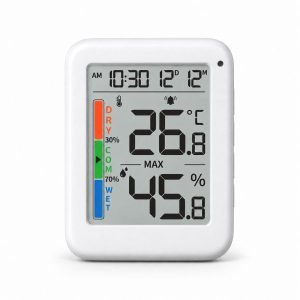
The newly developed indoor platform displays temperature, relative humidity, time, date and a color DRY/COMFORT/WET indicator. It provides maximum/minimum records, calibration adjustment and selectable sound/light temperature notifications. The confirmed measuring ranges are -9.9°C to 60°C and 10% to 95% RH, with 0.1-unit display resolution.
The product supports desktop and magnetic placement and requires two AAA batteries. Confirmed private-label options include logo branding, product color, color-box artwork and instruction-manual language or artwork. Changes to sensing, display content, alert logic, power or mechanical construction require separate engineering review.
A buyer should still compare the approved accuracy bands, alert behavior, mounting surface, packaging contents and project documentation with the intended application. That is the same process recommended for any model under evaluation.
Review the YGH6270 product page for its confirmed product information, compare the wider YGHao thermo-hygrometer range, or send the completed checklist through the YGHao contact page to discuss samples, documentation and confirmed project options.