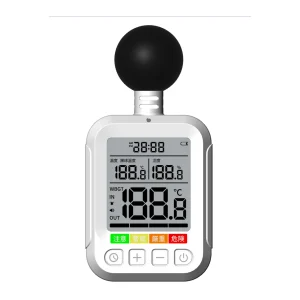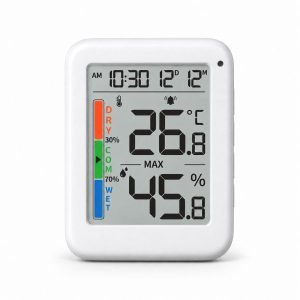
The OEM Checklist for Specifying Your Custom Thermometer Hygrometer
Why Most Thermometer Hygrometer Specs Break at Scale

Focusing on long-term stability data is critical for industrial-grade sensor procurement.
Most procurement teams treat the first thermometer hygrometer sample like a finished product, but that is a mistake. The real failure isn’t the sensor’s accuracy in a lab; it’s the assumption that a hand-calibrated prototype reflects the reality of a 5,000-unit run. When you sign off on a sample, you are often approving a unit built with hand-picked components and careful assembly. Once that design hits the line, housing tolerances, sensor aging, and assembly variance take over. That is where the specs break.
Choosing consumer-grade sensors for industrial use is the most common way to invite drift. A sensor that holds its calibration for a week in a climate-controlled office will often drift after three months of continuous exposure to industrial humidity or temperature cycling. If your spec sheet only lists peak accuracy, you are buying a snapshot, not a reliable instrument. Anyone who has managed a production run knows that the first 100 units usually look perfect, but the drift starts showing up in the last 1,000.
Before you issue a PO, stop looking at the peak accuracy and start asking for stability data. A reliable supplier should be able to show you how their sensors age under load over six months, not just how they perform on the day they leave the factory. If they can’t provide that, you aren’t buying an industrial asset; you’re buying a short-term tool. The goal is to define performance boundaries—specifically drift rates and recovery times—before the tooling is cut. If you wait until the units are on the dock to check for stability, you’ve already lost the margin you saved on the unit price.
Technical Benchmarks for Your Sensor Specs

Standardizing technical benchmarks helps mitigate risks in large-scale production.
Which sensor performance metrics actually dictate the failure rate of your industrial monitoring project?
Most procurement teams fixate on initial accuracy, but the real test is how the sensor behaves after six months of exposure to your specific environment. A sensor that reads within ±2% RH in a controlled lab can easily drift to ±5% if the housing material lacks chemical resistance or if the response time is throttled by poor airflow design. When evaluating suppliers, you need to look past the marketing spec sheet and demand data on long-term drift and recovery times.
| Feature | Industrial Standard | Why It Matters | Risk of Ignoring |
|---|---|---|---|
| Accuracy Class | ±2% to ±3% RH | Baseline for process control | Inconsistent batch quality |
| Response Time | T63 < 10s | Speed of environmental feedback | Delayed reaction to spikes |
| Housing Material | Industrial Polymer | Chemical and impact resistance | Structural failure in harsh use |
| Calibration Drift | < 1% RH / year | Long-term measurement reliability | Frequent, costly recalibration |
| Operating Range | -20°C to 60°C | Thermal envelope for deployment | Sensor failure in extreme heat |
Response time is the most overlooked variable. If your sensor is buried deep within an enclosure, a fast T63 rating is useless if the housing restricts airflow. We often see designs where the sensor is technically accurate but functionally blind because the air exchange rate is too low. Before you lock in a design, verify that the housing vents are positioned to allow natural convection, rather than relying on the sensor’s raw speed to compensate for poor mechanical integration.
Treat the operating range as a hard boundary. If your application approaches the edges of the thermal envelope, ask for the sensor’s performance curve at those extremes. A unit that performs perfectly at room temperature may show significant non-linearity near its maximum rated heat, leading to skewed data exactly when your system needs the most precision. If you are currently vetting a design, request our full technical spec sheet to verify your integration requirements.
Procurement Trade-offs: Choosing the Right Architecture
Every procurement decision for a thermometer hygrometer involves a trade-off between unit cost and long-term reliability. The most common mistake isn’t picking the wrong sensor; it’s picking an architecture that doesn’t match the reality of the deployment environment. If you are building for a controlled lab, you are paying for precision that becomes a liability in a high-humidity warehouse. If you are building for a consumer home, you are paying for housing aesthetics that might hide a sensor prone to drift. The goal is to define your performance boundaries—specifically drift rates and recovery times—before the tooling is cut.
High-Humidity Food Storage
In high-humidity environments, the primary enemy is sensor saturation. A standard polymer sensor will eventually ‘blind’ itself if it stays at 95% RH for too long, leading to a flat-line reading that looks like a system failure. When we consult on these projects, we push back on the urge to chase raw accuracy numbers. Instead, we prioritize sensors with fast recovery times and hydrophobic membranes that prevent moisture ingress. If your supplier is quoting a high-precision sensor without mentioning the recovery curve after a saturation event, they are selling you a lab instrument for a field application. That is where the RMA rate starts to climb.
Precision Lab Environments
Precision labs require a different set of trade-offs, where NIST-traceable calibration and high-frequency data logging are non-negotiable. Here, the architecture must support a stable, low-noise signal path. We often see buyers get caught by ‘integrated’ solutions that look clean on a spec sheet but lack the modularity for annual recalibration. In a lab setting, a device that cannot be easily removed or calibrated in-situ is a sunk cost. We advise clients to look for architectures that decouple the sensor head from the main processing unit, allowing for sensor replacement without discarding the entire calibrated assembly.
Consumer-Facing Home Monitoring
Consumer electronics demand a balance between aesthetic housing and cost-optimized sensor arrays. The pressure here is to keep the BOM low while maintaining a ‘premium’ feel. The trap is over-engineering the housing at the expense of airflow. If the sensor is buried deep within a sleek, sealed plastic shell, it will suffer from thermal lag, reporting the temperature of the internal PCB rather than the room. At YGhao, we often suggest a ‘vented-chassis’ approach that maintains a clean profile while ensuring the sensor has direct exposure to ambient air. It is a simple mechanical fix that saves thousands in field support costs later.
If you aren’t sure which architecture fits your volume, start by asking the supplier for their sensor recovery data at 95% RH; if they can’t provide it, you’re looking at the wrong component for your environment.
Common Pitfalls in OEM Development
If the sensor passes the initial lab test, the final product will perform the same.
A lab-bench sample is a best-case scenario. It ignores the reality of thermal mass, enclosure airflow, and the heat generated by your own internal components. When you rely on a sample that hasn’t been tested inside the final housing, you are essentially flying blind. Always insist on testing the sensor in a fully assembled, powered-on unit to see if the enclosure is trapping heat or choking airflow.
Calibration is a one-time factory setting.
Sensors drift. Assuming a pre-calibrated unit will stay accurate for years is a common oversight that leads to field failures. You need to account for the sensor’s long-term stability and define a clear recalibration schedule or drift-compensation protocol. If the supplier cannot provide data on expected drift rates over six months, you are taking on hidden maintenance costs.
The first 10 units are a representative sample for a 10,000-unit run.
Small batches are often hand-assembled by senior technicians using cherry-picked components. Mass production involves different tooling, automated lines, and material tolerances that can shift performance. YGhao recommends a pilot run of at least 100 units to catch the subtle manufacturing variances that don’t show up in a small-batch prototype.
| Pitfall | Why it matters | How to mitigate |
|---|---|---|
| Enclosure Airflow | Traps heat, skews humidity readings | Design ventilation paths near the sensor |
| Sensor Placement | Picks up internal PCB heat | Isolate sensor from heat-generating components |
| Calibration Drift | Inaccurate data over time | Request stability data and re-cal intervals |
| Sample Bias | Prototype doesn’t match mass output | Audit the full production line, not just the sample |
Is your design team ready to simulate the airflow inside your housing before you cut the mold?
Auditing Your Manufacturer’s Technical Capacity

Auditing the manufacturing process ensures that mass-produced units maintain prototype quality.
How do you verify that a factory can actually hold your sensor tolerances across a 5,000-unit run? Most buyers treat the first sample as the final word, but that is a dangerous assumption; a hand-tuned prototype is rarely representative of the units that come off the line during a high-speed shift. A real audit isn’t about reading a brochure—it’s about checking the calibration infrastructure that prevents your batch consistency from drifting over a 12-month lifecycle.
| Audit Checkpoint | Expected Evidence | Red Flag | Responsible Party |
|---|---|---|---|
| 12-Month Stability | 12-month sensor drift data | “Typical” specs without logs | Engineering |
| Calibration Rig | Third-party certs (ISO/IEC) | Uncalibrated in-house rigs | Quality Manager |
| Batch Consistency | SPC charts for last 3 runs | High unit-to-unit variance | Production Lead |
| Tooling Lead Time | Milestone-based schedule | Vague “as soon as possible” | Project Manager |
When you move from sample approval to mass production, the ‘golden sample’ trap is where most projects stall. A unit that performs perfectly in a lab is easy to build; maintaining that same accuracy when the assembly line is running at full capacity is a different challenge. If a supplier cannot produce calibration logs from their last three production batches, you are betting that their process is more stable than their data suggests. Anyone who has spent time on a factory floor knows that a machine running at 80% capacity often behaves differently than one running at 100%.
Custom tooling is another area where timelines frequently break. If your project requires a new mold, don’t just look at the initial lead time; ask for the schedule for the injection process fine-tuning. That is where the real delays happen. If you are currently vetting a supplier, ask them to show you the calibration rig they use for their standard thermometer hygrometer lines. If they can’t walk you through the certification process for that equipment, you should be looking for a different partner.
Next Steps: Securing Your Supply Chain with YGhao
Defining your sensor specs is only half the battle; the real test is whether your supplier can maintain that precision once the production line hits full speed. Most delays in this phase don’t come from the sensor itself, but from the gap between a hand-tuned sample and the reality of a 5,000-unit run. If you haven’t reviewed the production-line constraints before signing the PO, you are essentially gambling on the factory’s ability to replicate your prototype’s stability.
We prefer to look at the production constraints early. If you are ready to move forward, download the 2026 YGhao product catalog for a technical reference, or request a full spec sheet for your specific industrial application. If you have a design in hand, book a 20-minute engineering consultation to review it against our current manufacturing capabilities. For those ready to commit to a timeline, reach out to inquire about current MOQ and lead time windows for your OEM project.