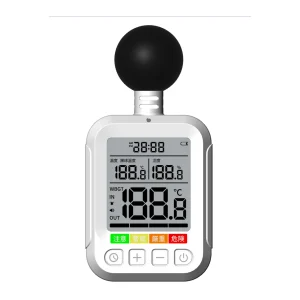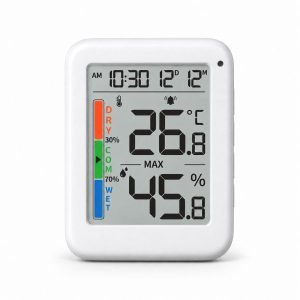
How to Customize Thermo-hygrometer Firmware to Extend Battery Life Beyond 12 Months
The 30-Day Battery Trap: What Happens When Datasheets Meet the Warehouse Floor
The procurement manager’s phone rings on a Tuesday morning with bad news from the cold storage facility: a 5,000-unit deployment of new wireless thermo-hygrometers has started dropping offline in week three. The spec sheet promised a two-year battery life, but the warehouse floor tells a different story. The devices were shipped with the factory-default firmware, polling the environment and transmitting data every sixty seconds. In a commercial setting, that default setting turns a low-power sensor into a battery drain.
The mistake is treating the hardware’s “low power” chip as a guarantee rather than a baseline. What actually kills the battery isn’t the sensor taking a reading or the LCD refreshing; it is the radio waking up to transmit that payload. A standard wireless module requires a massive power spike to establish a connection. When the firmware forces the radio to wake up for every single temperature fluctuation, even the highest-capacity lithium cells will flatline months before their rated lifespan.
Hitting the 12-month mark in production requires customizing the firmware to match the deployment environment. Experienced manufacturers like YGhao approach this by decoupling the sensor’s wake-up cycle from its transmission window. The device might wake up to log a temperature reading locally every five minutes, but it only powers up the radio to transmit a batched payload once an hour. If you want the battery to last, you have to negotiate the firmware’s transmission schedule before the first unit is assembled.
Firmware Polling vs. Transmission: The Power Consumption Math

Balancing local polling with batched radio transmission is the key to extending deployment life.
How much battery life does a custom thermo-hygrometer actually lose when it transmits data every minute instead of every hour?
The math usually surprises buyers who are used to consumer-grade spec sheets. A sensor waking up locally to check the temperature draws a tiny fraction of the power required to fire up a Wi-Fi, LoRa, or cellular radio. When you customize a thermo-hygrometer for industrial use, the firmware’s polling and transmission schedule is the single biggest lever you have for extending deployment life. If the factory default is set to stream data constantly—often done just to make the sample look responsive during a demo—a 5,000mAh battery that should last two years will be dead in three months. You have to look at the distinct power states to understand where the budget goes.
| Power State | Typical Draw (mA) | Customization Lever | Field Risk |
|---|---|---|---|
| Sleep Mode | < 5 µA | MCU and component selection | High baseline leakage drains the battery silently over months. |
| Sensor Polling | 2–5 mA | Polling interval (e.g., 5 mins vs. 1 min) | Missing rapid temperature spikes in highly sensitive environments. |
| Radio Transmission | 100–300 mA | Batching payloads (e.g., hourly vs. minutely) | Exponential battery drain, especially if the signal is weak and the radio retries. |
The baseline draw during sleep mode often looks negligible on paper. Checking the baseline draw against the active transmission spike reveals the true cost of wireless connectivity. Sleep mode leakage is constant, but the radio transmission requires a massive surge of energy to negotiate a network handshake, send the payload, and wait for an acknowledgment. Balancing real-time data needs against the exponential drain of constant radio use is where the actual engineering happens. If your cold chain requires minute-by-minute logs, the battery size and unit cost must scale accordingly.
Payload optimization is the standard workaround for this physics problem. Sending batched data once an hour saves exponentially more power than streaming every minute because the device avoids powering up the radio antenna sixty separate times. At YGhao, we usually advise buyers to decouple the two functions entirely. Let the sensor poll locally every few minutes to catch anomalies and log them to memory, but only wake the radio to transmit the batched payload once an hour—unless a critical temperature threshold is breached, which triggers an immediate alert. This hybrid approach gives you the safety of real-time monitoring without the battery penalty of real-time streaming.
Always specify separate intervals for local sensor polling and cloud transmission in your RFQ to protect your power budget.
Matching Firmware Profiles to Your Deployment Environment
(占位段:本节生成未返回可用 markdown — 模型返回空的 markdown 或未解析到 JSON;请在本任务 LLM 日志中查看本节 section_v1。 请稍后单段重生成或检查 LLM 配置。)
The ‘Always-On’ Display Trap and Other Spec Failures
(占位段:本节生成未返回可用 markdown — 模型返回空的 markdown 或未解析到 JSON;请在本任务 LLM 日志中查看本节 section_v1。 请稍后单段重生成或检查 LLM 配置。)
Auditing the Factory’s Firmware Customization Capability

A reliable manufacturing partner must demonstrate true engineering depth, not just hardware assembly.
Now that the physical limitations of the hardware are clear, the question is which suppliers actually have the engineering depth to rewrite the firmware around those boundaries. A factory that only swaps plastic casings cannot optimize a radio transmission schedule, and treating a hardware assembler like a software developer is a costly mistake.
| Audit Check | Standard Supplier Response | Tier-1 Factory Evidence | Risk if Skipped |
|---|---|---|---|
| Power Profiling | Quotes a theoretical battery life based on the MCU datasheet. | Provides oscilloscope traces showing distinct sleep, wake, measure, and transmit states. | The device drains the battery in weeks because the radio never fully sleeps. |
| Source Code Control | Offers to change the logo on a third-party generic app. | Demonstrates in-house repository control and can adjust the polling logic directly. | You are locked into a rigid transmission interval that ignores your deployment needs. |
| Burn-in Validation | Ships a functional sample and asks for immediate sign-off. | Runs a 72-hour burn-in test on the sample to verify actual power draw before mass production. | Firmware bugs that cause intermittent power spikes go unnoticed until the full batch is deployed. |
Any supplier can promise a two-year battery life on a PDF. The audit phase is where you force them to prove it on the bench. Manufacturers operating at the YGhao standard will not authorize mass production until the approved sample passes a 72-hour burn-in test, verifying that the physical power draw matches the theoretical profile under real-world network latency. If a vendor cannot produce an oscilloscope trace of their firmware’s sleep cycle, they are likely buying pre-flashed boards and relying on a third-party app they cannot modify. You need a partner who owns the code, not just the plastic mold.
The final step is locking those verified power profiles into the actual purchase order.
Structuring the PO for Custom Battery Life
(占位段:本节生成未返回可用 markdown — 模型返回空的 markdown 或未解析到 JSON;请在本任务 LLM 日志中查看本节 section_v1。 请稍后单段重生成或检查 LLM 配置。)