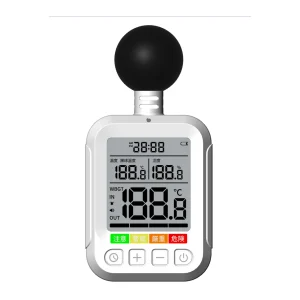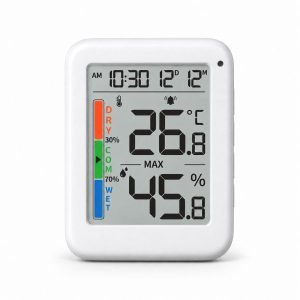
Upgrading Your Sensor Probes When You Customize Thermo-hygrometer Units for High-Moisture
Why “High-Accuracy” Sensors Flatline in the Washdown Room
In high-moisture environments, dynamic recovery from condensation is often more critical than static accuracy.
A custom thermo-hygrometer spec sheet boasting 99% accuracy means absolutely nothing if the probe reads 100% humidity for three hours after a routine washdown. This is the reality check that breaks most high-moisture sensor deployments. Buyers routinely source a premium capacitive chip, test it on a bench at a stable 25°C, and sign off on the batch. But on the floor, when hot water hits cold steel and condensation bridges the sensor window, that highly accurate chip flatlines. It stays pegged at maximum saturation until the water physically evaporates, triggering false alarms, halting production lines, and ultimately degrading the dielectric layer so badly that the probe needs replacing within three months.
The core procurement mistake is buying for static accuracy instead of dynamic recovery. In condensing environments, the goal isn’t to read through the water—which is physically impossible for a capacitive sensor—but to recover rapidly once the saturation event ends. A calibration-trained supplier like YGhao knows that the sensor chip itself is actually the last thing to look at. The real engineering happens in the airflow dynamics and the protective housing. If the filter pore size traps moisture rather than shedding it, even the most expensive sensing element will fail in the field.
Before approving a custom probe design for a wet environment, evaluate how fast the housing sheds water, not just how accurately the chip reads dry air.
Comparing Probe Architectures When You Customize Thermo-hygrometer Units
Balancing chemical protection with moisture recovery time is key when selecting probe housing materials.
Which probe housing actually survives a daily washdown cycle without drifting?
The answer depends entirely on how quickly the sensor needs to recover from saturation versus how much chemical exposure it has to block. A bare capacitive chip reacts instantly to ambient air changes, but chemical vapors in a wet environment will degrade its dielectric layer within a 12-month cycle. To prevent that drift, manufacturers wrap the chip in protective housings—typically a PTFE filter cap, sintered bronze, or a specialized heated micro-sensor setup. The trade-off is always recovery time. A dense filter blocks aggressive contaminants but traps moisture inside the cavity, turning a five-minute recovery into a three-hour flatline. When buyers customize thermo-hygrometer units with YGhao, the engineering conversation usually starts by matching the housing material to the specific vapor and particulate load of the room, rather than just defaulting to the highest IP rating.
| Probe Architecture | Best Fit Environment | Condensation Recovery | Primary Failure Mode | Unit Cost Impact |
|---|---|---|---|---|
| Bare Capacitive Chip | Clean rooms, HVAC ducts | Instant (if no droplets form) | Dielectric degradation from chemicals | Baseline |
| PTFE Filter Cap | Washdown zones, agriculture | 10–30 minutes | Pore clogging from dust or oil | Low to Medium |
| Sintered Bronze | Heavy industrial, high particulate | 1–2 hours | Severe oxidation over time | Medium |
| Heated Micro-sensor | Continuous condensing environments | Under 5 minutes | Heater burnout, complex calibration | High |
Sizing the Filter Pores
The most common spec failure happens when the filter pore size is mismatched to the environment. A 10-micron PTFE cap sheds water beautifully, but if the facility has high airborne particulate—like flour dust or aerosolized machine oil—those pores will clog within a week. Once clogged, the cap permanently traps moisture against the sensor, causing the unit to read a false 100% humidity until it is physically replaced. Verify that the pore size accounts for the actual particulate load on the floor, not just the volume of water hitting the casing.
Matching Your Spec When You Customize Thermo-hygrometer Batches for the Floor
(占位段:本节生成未返回可用 markdown — section_v1 call raised: Gemini :generateContent failed HTTP 429: Resource exhausted. Please try again later. Please refer to https://cloud.google.com/vertex-ai/generative-ai/docs/error-code-429 for more details. 请稍后单段重生成或检查 LLM 配置。)
The “Waterproof” Trap and Other Costly Spec Failures
(占位段:本节生成未返回可用 markdown — 模型返回空的 markdown 或未解析到 JSON;请在本任务 LLM 日志中查看本节 section_v1。 请稍后单段重生成或检查 LLM 配置。)
Factory Audit Checks for High-Moisture Customization
(占位段:本节生成未返回可用 markdown — 模型返回空的 markdown 或未解析到 JSON;请在本任务 LLM 日志中查看本节 section_v1。 请稍后单段重生成或检查 LLM 配置。)
Locking the Golden Sample and Structuring the PO
(占位段:本节生成未返回可用 markdown — 模型返回空的 markdown 或未解析到 JSON;请在本任务 LLM 日志中查看本节 section_v1。 请稍后单段重生成或检查 LLM 配置。)