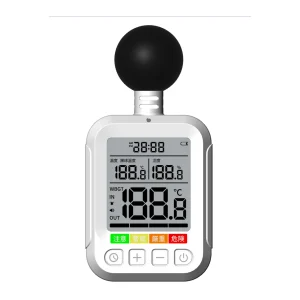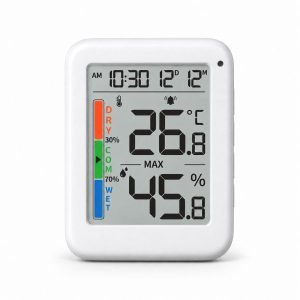
Choosing a Retail-Ready Thermo-hygrometer: Sourcing Tips to Reduce Store Return Rates
Why Wholesale Thermo-Hygrometers Drift Before Reaching Store Shelves

A conceptual look at transit microclimates where heat and moisture interact within sealed spaces.
Ninety percent of early-life accuracy complaints on bulk thermo-hygrometer shipments trace back to sea-freight transit conditions, not bad factory calibration. When you lock ten thousand consumer units inside a steel shipping container for thirty or forty days, you are exposing them to a brutal, stagnant microclimate. Temperatures inside these containers easily hit 50°C while relative humidity spikes to 90% during tropical port layovers. Under these conditions, cheap unrefined housing plastics and packaging adhesives begin to outgas volatile organic compounds (VOCs). These airborne chemicals settle directly onto the delicate sensor membranes, shifting the baseline calibration before the container is even unloaded. By the time the cargo arrives at a regional distribution hub and finally lands on Store Shelves, Sensor accuracy has already shifted.
This reality forces retail procurement teams to make a cold financial trade-off on sensor architecture. Supermarket bargain lines retailing at the $5 to $10 price point almost always run on cheap resistive ceramic paste elements. These sensors are incredibly vulnerable to moisture-induced degradation, routinely drifting far past their nominal 5% RH limits after a few weeks of exposure. If you are selling an entry-level Store Shelves Sensor line, you might accept this return rate as a cost of doing business, but professional smart-home lines or industrial monitors require capacitive polymer thin-film ICs that resist environmental poisoning. To protect buyers from this risk without triggering a spike in unit costs, suppliers like YGhao run a mandatory 24-hour pre-shipment thermal and humidity stress-test aging protocol. This burn-in cycle forces early-life component drift to happen on the factory floor rather than in transit, letting engineers screen out unstable chips before packaging.
When sourcing at high volumes, a factory laboratory spec sheet is useless unless it is backed by actual stress-test data. Never sign off on a high-volume purchase order without demanding the supplier’s certified 24-hour aging log to prove the sensors can survive the container journey.
Sensor IC Analysis: Swiss Capacitive vs. Low-Cost Domestic ICs

High-precision sensor architectures rely on stable thin-film layers to maintain accuracy.
Why do low-cost thermo-hygrometer sensors drift so fast?
The physical divide is simple: unbranded resistive components use screen-printed ceramic pastes that oxidize and swell under humidity, whereas premium Swiss capacitive integrated circuits (ICs) measure electronic charge changes across a highly stable polymer thin-film. During a 30-day container voyage, stagnant heat and outgassing packaging materials degrade these cheap ceramic pastes permanently, warping the sensor’s physical lattice before the cargo ever reaches your warehouse. For brands buying in bulk, saving pennies on the initial bill of materials (BOM) usually triggers a wave of early-life failures that quickly wipes out any theoretical margin.
| Sensor IC Type | Accuracy Tolerance (RH/Temp) | Annual Drift Rate | Estimated Unit Cost Impact | Optimal Retail Segment |
|---|---|---|---|---|
| Swiss Capacitive ICs (e.g., Sensirion SHT40) | ±1.8% RH (from 20% to 80% RH) / ±0.2°C (from 0°C to 60°C) with active condensation healing | <0.25% RH per year under nominal warehouse and household operations | +$1.20 to +$2.50 per unit over base resistive components, depending on order volume | Premium IoT smart home devices, professional cold-chain monitoring, and high-accuracy HVAC systems |
| Standard Domestic Capacitive ICs (e.g., ASAIR / Sensylink) | ±3.0% RH (from 30% to 70% RH) / ±0.5°C with basic protective membrane filters and calibrated registers | <0.50% RH per year; susceptible to localized drift if exposed to continuous high-humidity environments | +$0.40 to +$0.80 per unit, striking a functional balance for mid-range consumer lines | Mass-market connected appliances, mid-tier consumer thermo-hygrometers, and app-controlled home sensors |
| Low-Cost Resistive Ceramic Sensors (Unbranded) | ±5.0% to ±8.0% RH / ±1.0°C to ±2.0°C with no onboard digital calibration or offset registers | >2.00% RH per year; often drifts to ±8.0% RH or worse within 90 days of factory production | Baseline ($0.00 reference index) but carries hidden liabilities in warranty claims and returns | Budget promotional giveaways, low-end bulk stock, and short-lifecycle disposable analog meters |
Sourcing Verdict
Sourcing decisions should follow your target retail channel’s return tolerance rather than the upfront factory quote. If you are shipping to major big-box retailers with strict RMA penalties, saving $0.40 on a cheap resistive sensor is a classic false economy; you will lose your entire margin on the first wave of store returns. At YGhao, we balance this risk by offering factory-direct pre-shipment aging on standard domestic capacitive ICs, providing a stable product that survives transit without forcing you to pay the premium Swiss license fee.
Component Budgets for Mass Retail vs. Premium Connected Brands
The shift supervisor at 6:00 AM is already looking at a pallet of rejected housings because the high-gloss ABS did not match the golden sample under the light box. When you are managing high-volume runs, aligning technical Component Budgets with the retail price point and your customer’s chargeback terms is what keeps you profitable. A three-cent difference in the Bill of Materials (BOM) can determine whether an entire production run is viable or if it will end in a massive Quality Control failure at destination customs.
Scenario A: Sourcing Low-Cost, Non-Connected Promo Units For Mass Retail
If you are manufacturing basic, non-connected desktop thermo-hygrometer lines designed to retail under $10, every fraction of a cent in the BOM is a battleground. Sourcing Low-cost resistive sensors is often the only realistic path here; a Swiss capacitive sensor would instantly consume your entire margin. These resistive sensors are prone to drift over time, but for general consumer promo items, a slight variance is commercially acceptable. To prevent high return rates without inflating production costs, factories often write a hard offset calibration into the microcontroller firmware. This ensures the batch passes initial Quality Control inspections and provides acceptable consumer performance for a budget item without forcing you to pay for expensive Swiss silicon.
Scenario B: Sourcing Connected Smart-Home Units
For Premium Connected Brands The math is different because poor sensor accuracy leads to immediate product returns and negative app reviews. If an app displays historical climate graphs, a persistent humidity drift of 5% or 10% is immediately visible to the user as a jagged, unrealistic line on their screen. When Sourcing Connected Smart-Home Units Connected to Wi-Fi or BLE, you cannot afford to skimp on the sensor IC. A major brand owner shipping to European retail programs recently faced this exact dilemma: delay a 50,000-unit launch to source stabilized capacitive sensors or proceed with unaged components. By implementing a specialized pre-shipment aging protocol on domestic capacitive sensors with a partner like YGhao, they kept their field return rate under 1.2% while bypassing Swiss licensing fees.
Scenario C: Calculating the Return-Rate Threshold
Every sourcing manager needs to know how many product returns it takes to wipe out the initial savings of a cheaper domestic sensor. If you save $0.15 per unit by choosing an unaged sensor on a 20,000-unit run, your total upfront savings is $3,000. However, if that choice results in a 3% increase in retail returns due to drift, and each returned unit costs you $10 in reverse logistics and retail penalties, you lose $6,000. That means a minor calibration drift does not just annoy customers; it actively drains your balance sheet. A good rule of thumb is that if your estimated return rate from sensor drift exceeds 1.5%, the upfront savings of a cheaper unaged sensor is a mathematical illusion.
Sourcing Traps: Why Laboratory Spec Sheets Fail on the Production Line
Three hidden variables dictate whether a bulk run of 10,000 units actually holds its accuracy once it hits warehouse shelves. While a laboratory spec sheet shows what a sensor can do under idealized thermal stabilization, it says absolutely nothing about real-world conditions. This disconnect is why a beautiful lab prototype is meaningless once it transitions to Production Line Mass assembly, chemical outgassing inside shipping containers, and seasonal component swapping.
The golden showroom sample performs identically to a mass-production run of 10,000 units.
It won’t, and the reason is cycle time. R&D engineers hand-calibrate prototypes over hours in slow-cycle thermal chambers to ensure perfect linearity. But on a high-speed assembly line, a factory cannot afford a four-hour soak for a standard thermo-hygrometer. Instead, devices get a quick, single-point humidity blast on automated rigs to keep up with the line’s beat rate. If the sensor has non-linear errors at the extremes—say, near 20% or 80% RH—this rapid check misses them entirely. To catch this before shipment, the factory has to pull random batch samples and run them through multi-point chambers to verify they actually match the original R&D baseline.
Housing plastic is purely cosmetic and cannot degrade internal sensor accuracy.
This is a classic blind spot. Cheap, recycled ABS housings release volatile organic compounds (VOCs) that slowly poison the internal sensor membrane when sealed inside retail boxes. During transit and storage, these trapped VOCs outgas directly into the tight micro-environment of cardboard packaging, coating the sensitive polymer thin-film. This chemical contamination permanently alters the sensor’s dielectric properties, driving severe humidity drift before the consumer even opens the box. Procurement teams can bypass this failure entirely by specifying virgin, non-recycled ABS or low-emission polycarbonate to keep the internal cavity clean.
A signed Bill of Materials guarantees the factory will use the approved sensor IC on subsequent batches.
Factory Audit Protocol: Verifying a Thermo-hygrometer Manufacturer

Inside a modern factory testing lab where multi-point chambers calibrate devices to rigorous standards.
How do you audit a thermo-hygrometer factory?
Most sourcing teams look at certificates, but this Factory Audit Protocol shows a Manufacturer How to verify active, physical calibration on the shop floor.
| Audit Station | Expected Evidence | Supplier Red Flag | Responsible Party |
|---|---|---|---|
| SMT Storage & IC Handling | Continuous ESD and moisture-sensitive device (MSD) logs matching IPC/JEDEC J-STD-033, showing storage strictly below 5% RH. | Open tape-and-reel packaging exposed to ambient warehouse air, letting sensor polymers absorb moisture and ‘popcorn’ (micro-crack) during soldering. | SMT Line Lead |
| Environmental Chamber Testing | ISO/IEC 17025 calibration certificates for the chambers and daily automated run logs showing target curves (e.g., 15°C, 25°C, 45°C; 30%, 50%, 80% RH). | Chambers sitting dark, unplugged, or used as storage shelves on the main production floor, with staff relying purely on nominal IC datasheet specs. | Calibration Lab Manager |
| Serialized Data Traceability | Live relational database query displaying MAC addresses or UUIDs matched to calibration timestamps, reference chamber readings, and deviation offsets. | Hand-written logs or sequential serial blocks showing identical, flatline accuracy metrics across thousands of units with no physical timestamp variance. | IT Systems & Database Engineer |
| Solder Joint Inspection | 3D Solder Paste Inspection (SPI) volume reports and Automated Optical Inspection (AOI) pass/fail logs for every PCB panel before and after the oven. | Manual visual inspection with low-power magnifying glasses as the sole method to verify lead-free sensor solder joints. | SMT Line Supervisor |
If a factory cannot pull up live database records matching a device’s MAC address during your walkthrough, they are skipping calibration and relying on nominal sensor values. This shortcut guarantees that at least 5% of your batch will drift outside acceptable limits before it even clears customs. At YGhao, we prevent this by housing our own SMT lines and operating automated multi-point chambers that tie every serialized PCB directly to its environmental log. Buyers are welcome to book a live video walkthrough of our labs to verify these stations in real-time.
Protecting Retail Margins: Order Parameters and Sourcing Next Steps
While shifting your component focus from raw unit cost to long-term field stability protects your paper margins, the actual profitability of a wholesale thermo-hygrometer shipment is won or lost during shipping and handling. A retail category manager might save fifteen cents per unit by skipping sensor isolation barriers, but a 3% store return rate driven by transit drift will quickly trigger retailer penalties that wipe out that entire saving. Spending marginally more on the factory floor—specifically on pre-aged capacitive ICs, sensor-chamber isolation barriers, and high-density PET vacuum packaging—is a direct hedge against the high-humidity microclimates of container shipping. If you are shipping forty-day ocean freight routes, locking in these protective manufacturing steps during your sourcing next steps while negotiating your contract is the only way to make sure your landed margin matches your projected margin.
For procurement teams ready to move from technical specifications to a physical production run, aligning with these quality baselines requires clear manufacturing boundaries that match your market scale. At YGhao, we structure our production runs to accommodate both regional pilot phases and full-scale retail rollouts. For brands utilizing stock casing designs to test consumer response, our standard MOQ begins at 1,000 units, lowering the initial capital barrier. For fully customized OEM casing designs, custom-calibrated sensor firmware, or private-label retail packaging, the minimum production run is set at 5,000 units. To verify our stabilization processes and review full mechanical tolerances before drafting your purchase order, you can download the latest YGhao product catalog and engineering spec sheets or request our raw sensor reliability test reports.