Securing a Stable Custom Digital Clock Supply Chain: Navigating Unit Costs and Shenzhen Factory Audits
The Custom Tooling Dilemma: When to Modify a Standard Chassis vs. Cut a New Mold

Precision and modular tooling require careful design alignment before cutting molds.
On a Monday morning, a hardware procurement manager opens an RFQ response for a 10,000-unit custom digital clock run, only to find the unit price has jumped 40% over the standard catalog rate because of a seemingly minor housing tweak. Basic catalog unit pricing breaks down the moment a buyer asks for custom LED/LCD configurations, a custom-colored housing, or specialized firmware to trigger external relays. Standard clocks run on highly optimized, pre-existing molds designed for high-speed automated assembly. Modifying that workflow isn’t just a setup fee; it’s a structural disruption where the factory must manually adapt the physical Standard Chassis.
The core challenge—The Custom Tooling Dilemma—is knowing where a low-cost cosmetic adjustment like CNC-routing a slot ends and where a structural overhaul requiring a New Mold begins. To keep margins predictable, procurement teams and product managers must map the progression from the initial design freeze to 3D-printed prototype approvals and hard-tooled production. At YGhao, with 25+ years of export manufacturing and mold-making experience in Shenzhen, we’ve operated our own in-house tooling facility since 1999 to help buyers navigate these capital choices. If a design modification requires shifting internal screw bosses or altering wall thicknesses to fit a custom PCB, modifying the existing mold insert is technically possible, but it frequently creates weak joints that fail drop tests.
Cutting a new steel mold carries a heavy front-end non-recurring engineering (NRE) cost, but it eliminates the manual labor bottleneck of post-processing on high-volume runs. As a rule of thumb for hardware procurement: if a chassis modification changes the external footprint or load-bearing internal structures by even half a millimeter, cutting a dedicated mold is ultimately cheaper than paying manual machining surcharges on anything over 5,000 units.
Amortizing Your NRE: Why Customization Complexity Sets Your Real Unit Cost
How do custom digital clock NRE fees and design choices affect the final unit price in bulk sourcing?
The actual cash outlay for a custom digital clock order is rarely just the unit price on the invoice; it is that number plus the upfront non-recurring engineering (NRE) tooling fee amortized across your run. When a procurement team miscalculates this, they end up paying $15,000 for a bespoke injection mold on a 1,000 units pilot run, which adds a quiet but devastating $15 surcharge to every single unit shipped. Grouping your project into the correct complexity tier before signing the PO is the only way to avoid subsidizing a factory’s tooling assets at the expense of your own margin.
| Customization Tier | Target Buyer & Fit | Costs & Timelines | Critical Failure Points | Amortization Verdict |
|---|---|---|---|---|
| Cosmetic Branding (Logo printing, custom housing PMS colors) | Retail brands and promotional buyers. Fits projects using standard off-the-shelf PCBs. | • NRE: $0 to $500 • MOQ: 1,000 units • Lead Time: 30 days | • Off-spec Pantone matching under warehouse light. • Fast surface ink wear on high-touch buttons. | Amortizes immediately. Recommended for low-margin retail and rapid seasonal runs. |
| Semi-Custom Modular (Custom LCD glass layout, proprietary firmware) | Industrial, medical, and fitness OEMs. Fits specialized display interfaces on stock drivers. | • NRE: $3,000 to $8,000 • MOQ: 3,000 units • Lead Time: 60 days | • LCD segment bleed or low contrast under direct glare. • Uncalibrated timing drift under extreme temperatures. | Amortizes cleanly at 3,000 units or more. Highly efficient for specialized clinical timers. |
| Fully Custom ODM (Bespoke chassis, custom PCBA design) | Enterprise electronics and industrial equipment. Required for proprietary shapes. | • NRE: $15,000+ • MOQ: 10,000 units • Lead Time: 120 days | • Mold shrinkage warping plastic bezel lines. • Delayed FCC, CE, or RoHS compliance certifications. | Amortizes strictly above 10,000 units. Essential for proprietary industrial enclosures. |
Calculating the Real Tooling Break-Even Point
To evaluate if custom tooling makes sense, use a simple payback calculation: divide your total NRE fee by the difference between the standard unit price and the volume-discounted custom unit price. For example, if a custom run drops your unit price by $2.00 but requires an upfront $8,000 tooling fee, your break-even point is exactly 4,000 units—any volume below that means you are paying a premium for customization.
If your projected first-year volume cannot absorb the tooling amortization down to less than ten percent of the target unit cost, stick to standard tooling and use pad printing to mimic a custom build.
Volume vs. Asset Fit: Three Real-World Sourcing Scenarios for Custom Digital Clocks
A redline markup on a custom digital clock power supply schematic usually reveals the same oversight: a team specified high-draw multi-digit LEDs but expected the unit to run for two years on AAA batteries. Display choices, volume, and certifications dictate the entire manufacturing path. Matching your product spec to the right production line setup determines whether your project succeeds or drowns in unrecoverable tooling costs.
Scenario A: Sourcing for a Volume Retail Launch (10,000+ Units)
On a consumer-facing Volume Retail Launch, every penny shaved from the bill of materials (BOM) preserves margin over a 10,000-unit run. Specifying a custom static LCD glass layout over a standard active LED matrix allows the unit to run on coin cells for up to two years instead of demanding a mains adapter. While this direction requires a $5,000 custom glass tooling charge and a $15,000 multi-cavity plastic injection mold, these upfront costs amortize down to pennies per unit. Low-draw static LCD panels avoid the high-current drivers and thermal management hardware that drive up assembly costs on retail shelves.
Scenario B: Industrial Equipment Integration (Rugged Timers)
When embedding Rugged Timers directly into a medical console, the priority shifts from unit-cost minimization to electromagnetic isolation and environmental survivability. These Industrial Equipment Integration setups require onboard temperature and humidity sensors that are pre-calibrated and shielded against high-voltage industrial interference to prevent timing drift. Buyers must prioritize factories like YGhao that can verify legitimate CE, FCC, and RoHS certifications on the raw components and completed PCBs rather than relying on unverified declarations. To survive high thermal stress, these systems employ high-visibility static LCD displays backed by custom LED light guides, bypassing the high power draw of traditional LED panels.
Scenario C: Smart Home NPI Pilot (1,000-Unit Proof of Concept)
For a smart home connected clock pilot run of 1,000 units, cutting new molds is a commercial dead end that sinks the project before it reaches the field. Instead of investing tens of thousands of dollars in bespoke plastic tooling, smart procurement teams select an off-the-shelf modular enclosure and modify it via high-precision CNC routing to accommodate custom port configurations. This replaces heavy upfront tooling fees with a minor setup charge, allowing the team to allocate budget toward premium Wi-Fi modules and high-precision crystal oscillators. This modular strategy ensures the first-generation product gets to market fast enough to gather real user feedback before locking in high-volume tooling.
Why Custom Digital Clock Batches Fail: Drift, Unstable Molds, and Rejected Customs Paperwork
Physical execution is where a custom digital clock order succeeds or dies, regardless of how clean your upfront NRE calculations look on paper. When production starts, the risk shifts entirely from the balance sheet to the physical realities of the assembly line.
Any factory-held CE or FCC certificate automatically covers a customized digital clock model.
Customs officials do not just scan the carton for a logo; they cross-reference your specific model code and internal board layout against the original test report’s block diagrams. If you changed the display panel, added a backup battery, or altered the casing of your custom digital clock, the original EMC testing is legally void. A factory trying to cut corners will often hand you a baseline certificate from five years ago. However, if customs flags a mismatch at the port of entry, you face Rejected Customs Paperwork Three days before your product launch, leaving your container stranded in a bonded warehouse while daily storage fees compound. You must demand a localized test report or an official amendment referencing your exact customized model code.
All quartz crystals perform identically, so timekeeping accuracy is standard across suppliers.
Severe timekeeping drift is almost always a physical hardware matching issue, not a software bug. Low-cost 32.768 kHz tuning fork crystals can easily drift by three to five minutes a month if the supplier skips load capacitance matching on the trace layout. If the trace impedance on your custom board does not match the crystal’s rated load capacitance—which typically ranges from 6pF to 12.5pF—minor temperature fluctuations will rapidly compound the error. For commercial or industrial facilities, a clock that cannot keep time is worse than useless. Before assembly begins, have your supplier’s engineering team run a trace calibration test to match the crystal’s capacitance to the board.
Low-cost, unhardened steel molds are fine for short runs because cosmetic flaws are just visual.
The Shenzhen Factory Audit Checklist: SMT Line Capacity and On-Site Testing Equipment
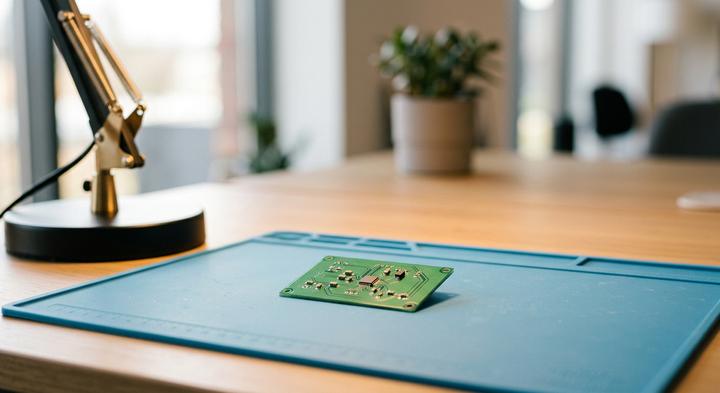
In-house SMT capabilities and cleanroom standards are vital for custom digital clock calibration.
Once your amortization math justifies cutting a custom mold rather than modifying standard stock, your risk shifts from the spreadsheet directly to the physical factory floor. The Shenzhen Factory Audit is where a promising custom digital clock design either becomes a reliable high-yield product or turns into an endless cycle of RMAs. Sourcing managers often get distracted by clean reception areas, but real reliability is decided in the dirty, high-heat zones of the facility.
Subcontracting SMT (Surface Mount Technology) to an unvetted local workshop is the quickest way to ruin a custom digital clock run. It introduces variables in solder paste viscosity, reflow temperature profiles, and ESD compliance that no desktop audit will ever catch. When assembly is outsourced to low-overhead backyard shops, the primary supplier loses custody of the PCBA. Display flickering or severe time drift won’t show up until the containers land at your warehouse. At YGhao, we keep our SMT lines in-house and climate-controlled because outsourcing core electronics means giving up control over the clock’s accuracy. An auditor must physically inspect the Site Testing Equipment Once they step onto the production floor, checking calibration dates before discussing schedules.
| Ask | Expected Evidence | Red Flag | Responsible Party |
|---|---|---|---|
| In-House SMT Verification | Climate-controlled cleanrooms with active solder printing, multi-zone reflow ovens, and AOI machines with logged runtime reports. | SMT area is dusty, inactive, or key PCB assembly steps are contracted out to unnamed off-site workshops. | Sourcing Manager & Lead Quality Engineer |
| Timekeeping Calibration | High-precision frequency counters and digital oscilloscopes verifying 32.768 kHz crystal oscillators under active load. | No timing calibration rigs on the floor; the line supervisor relies purely on the crystal vendor’s raw datasheet. | Hardware Design Engineer |
| Environmental Stress Testing | Programmable thermal chambers running cycles from -20°C up to 70°C and calibrated ESD simulators with active logbooks. | Chambers are unplugged, used for storage, or lack active stickers showing current-year calibration. | Quality Assurance Lead |
| Tooling & Injection Facilities | On-site CNC machines, EDM, and hydraulic injection presses with active preventive maintenance logs. | Housing molds stored outdoors under tarps, showing rust, or tooling is handled by an unvetted third-party vendor. | Sourcing Manager & Tooling Engineer |
Balancing Commercial Capacity and Engineering Validation
De-Risking Your Production Run: Aligning Custom Engineering with Daily Factory Output
Now that the amortization formulas are locked in, the practical hurdle is getting those CAD files to behave on a live assembly line. When modifying a custom digital clock, a procurement team often focuses on the upfront cosmetic changes and overlooks how those tweaks disrupt the factory’s routine. If you do not establish a direct line to the factory’s engineering desk, you invite unauthorized component swaps on the line. Without a formal, signed-off Engineering Change Order (ECO) to lock down the bill of materials, a target $5.00 unit can easily ship with an unapproved, lower-grade capacitor just because a line supervisor had to hit a shift target. At YGhao, we mitigate this by running all modifications through our 4,000-square-meter Shenzhen facility, which operates under strict ISO 9001 and BSCI quality audits. We produce over 1.6 million units annually, meaning our processes are geared for high-volume repeatability, not guesswork. Aligning Custom Engineering with Daily Factory Output Now requires that every schematic tweak is validated through direct Design for Manufacturing (DFM) reviews before the first tooling cycle begins.
Risking Your Production Run on untested housing tolerances or unvetted PCB traces is a costly way to learn that paper designs do not automatically translate to high-speed assembly. Instead of waiting for the first pre-production batch to fail, you can clear these technical bottlenecks while your tooling budget is still on paper. To see how your custom digital clock drawings will run on our lines, send your current mechanical files or PCB layouts to our Shenzhen engineering desk for a practical DFM review. We will return a clear, itemized report detailing draft angles, component clearance, and any potential cost-saving structural adjustments.