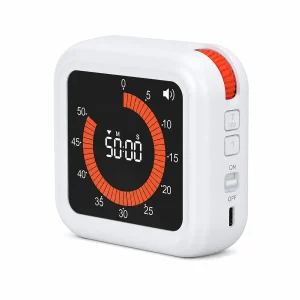
Custom Digital Kitchen Timer Hardware for High-Volume Commercial Kitchens
Why Standard Kitchen Timers Fail in Commercial Environments

Focusing on industrial-grade tactile interfaces is key to surviving high-volume kitchen environments.
Most kitchen timers are built for a home environment where they might see five or ten button presses a day. Put that same unit on a professional line, and you aren’t just buying a cheap tool; you are signing up for a recurring replacement cycle. The failure isn’t usually the electronics themselves, but the physical interface. When a timer dies during a dinner rush, the cost isn’t the $10 unit price—it is the operational friction and the labor time spent swapping out hardware every three months.
Why Standard Kitchen Timers fail comes down to the membrane buttons. These are designed to be thin and inexpensive, but they rarely survive 5,000 cycles in a grease-heavy environment. Once that top layer of adhesive starts to lift, oil and moisture seep directly onto the PCB. You get ghost inputs, unresponsive buttons, or a dead display. It is a common trap: procurement teams look at the unit cost, but they ignore the fact that a consumer-grade timer is essentially a disposable item in a commercial kitchen.
Heat is the other silent killer. Standard ABS plastic casings warp when they sit near a fryer or a hot holding station for twelve hours a day. Once the casing warps, the battery door loses its seal and the display alignment shifts. At YGhao, we focus on Commercial Environments Reliability by using industrial-grade polymers that resist heat-induced warping and tactile, sealed interfaces that actually hold up to high-volume use. If you are currently replacing your timers more than twice a year, stop looking at the price tag and start asking your supplier for their cycle-test data. If they cannot show you the results of a 50,000-cycle test, you are buying a home-use product that will fail on your line.
Technical Specs That Define Industrial Reliability

Distinguishing between retail-grade and industrial-grade hardware requires looking at core component benchmarks.
How do you distinguish a timer that lasts three years from one that dies in three months? It comes down to the specific hardware choices made during the design phase. If you are sourcing for a high-volume kitchen, you need to look past the retail-grade specs and focus on the components that actually take the abuse of a professional line.
| Feature | Retail-Grade Spec | Industrial-Grade Benchmark | Procurement Risk |
|---|---|---|---|
| Switch Cycle Life | 5,000–10,000 cycles | 50,000+ cycles | High (Button failure) |
| Ingress Protection | None / IP20 | IP54 or higher | High (Grease ingress) |
| Display Contrast | Low (Indoor only) | High-Intensity LCD/LED | Medium (Visibility) |
| Power Source | AA/AAA Battery | Hardwired DC / USB-C | Low (Operational downtime) |
Most failures in commercial kitchens happen at the interface. If the buttons aren’t rated for at least 50,000 cycles, you are essentially buying a disposable item. Similarly, if the unit lacks an IP54-rated seal, grease and cleaning agents will eventually find their way to the PCB. We see this constantly: a timer looks fine on the outside, but the internal contacts are corroded because the manufacturer saved a few cents on the gasket.
Power delivery is the other hidden cost. Battery-operated units are easy to deploy, but they create a maintenance loop that eats up your staff’s time. For fixed stations, we always recommend hardwired DC power or a stable USB-C connection. It removes the risk of a timer dying in the middle of a rush. When you request a quote, ask the supplier for their cycle-test data. If they cannot provide a report for these benchmarks, you are likely looking at a consumer-grade product rebranded for industrial use.
Selecting Hardware for Your Specific Kitchen Workflow
Hardware selection isn’t about finding the ‘best’ timer; it’s about matching the device to the specific friction points on your line. If you’re running a fast-casual setup, your biggest enemy is the time lost to manual resets during a rush. You need a multi-channel system that handles Channel Synchronization In, allowing a cook to trigger four distinct stages of a menu item with a single touch. If your current hardware requires two hands to reset or lacks programmable presets, you’re losing seconds on every ticket. Don’t settle for generic count-up timers; if the supplier can’t provide a firmware spec for one-touch sequencing, keep looking.
In fine-dining, the pass is a hostile environment for electronics. Between the heat radiating from the grill and the steam from the plating area, standard plastic housings warp and internal buttons fail within months. We’ve found that Heat Resistant Materials In the form of stainless-steel housings with sealed, capacitive touch interfaces are the only way to stop the ‘ghost-touch’ errors that plague cheaper units. If you’re replacing timers more than twice a year, you’re paying for the same failure repeatedly. Take a sample, put it in your hottest station, and run it for 30 days. If the seal holds and the buttons stay responsive, you’ve found a unit that can actually survive the shift.
For industrial catering, the challenge shifts from durability to visibility. A standard 80dB beep is useless when you’re standing next to industrial dishwashers or high-capacity exhaust fans. You need Decibel Alert Systems Industrial grade, which often means moving away from standalone units toward a centralized, wall-mounted display that integrates with external alarm relays. If the supplier can’t provide a wiring diagram for relay integration, they’re selling you a consumer-grade product with a louder speaker, not a professional tool. Your Specific Kitchen Workflow should dictate the hardware, not the other way around.
Procurement Traps: What Drives Your Total Cost of Ownership
If the sample passes, production will too.
A sample is a snapshot, not a guarantee. In high-volume manufacturing, the gap between a prototype and a production batch is often filled with ‘value engineering’—a polite term for swapping components to protect the supplier’s margin. If your contract doesn’t specify the exact bill of materials (BOM) and a staged inspection plan, you are essentially betting that the factory won’t cut corners on the second run. Always demand a signed BOM and a QC report that matches the specific components used in your approved sample.
MOQ and lead time are fixed numbers.
These figures are rarely static; they are levers. A supplier might quote a low MOQ by using off-the-shelf, non-standard mounting hardware that creates a nightmare for your maintenance team later. Similarly, lead times often exclude the ‘hidden’ weeks required for tooling adjustments or firmware validation. When you receive a quote, ask how the unit price changes if you move to standardized mounting or if the lead time includes a pre-production pilot run.
| Cost Driver | Impact on TCO | Procurement Fix |
|---|---|---|
| Battery Life | High (Labor/Waste) | Request 50,000-cycle test data |
| Mounting Hardware | Medium (Installation) | Standardize to universal VESA/bracket |
| Membrane Switches | High (Failure Rate) | Specify industrial-grade silicone |
| Firmware Updates | Low (Operational) | Confirm OTA or port access |
The lowest unit price is the best deal.
This is the most expensive mistake in industrial procurement. A digital kitchen timer that saves you $2 per unit but requires a battery change every three months creates a labor drain that eclipses the initial savings within the first year. When evaluating a quote, calculate the total cost of ownership over a 24-month horizon, factoring in the frequency of unit failure and the man-hours required for replacement. A slightly higher upfront investment in a sealed, hardwired unit often pays for itself by eliminating the battery-replacement cycle entirely.
Is your current supplier ready to provide the reliability data needed to justify that upfront investment?
How to Audit Your Timer Manufacturer

Auditing a manufacturer’s QC logs is the most effective way to ensure long-term reliability.
How do you know if a supplier is actually building industrial-grade timers or just slapping a logo on a consumer-grade unit? Most factories will talk about their quality standards, but the real story is in the paperwork they are willing to share. If you ask for technical validation and they stall, it is usually because the testing was never done in the first place.
| Audit Checkpoint | Expected Evidence | Red Flag | Responsible Party |
|---|---|---|---|
| Tactile Switch Life | 50,000+ cycle test report | “Standard” or “Retail” rating | Engineering |
| IP-Rating Compliance | Independent lab certification | Self-declared rating only | Quality Control |
| Firmware Logic | Custom interval programming | “Fixed” or “Hardcoded” UI | R&D Team |
| Pilot Batch Capacity | Documented small-run process | Refusal of <500 unit runs | Account Manager |
When you are vetting a partner like YGhao, look for the gap between their sales pitch and their actual QC logs. A cycle-life report for the tactile switches is the most telling document you can request; it proves the hardware can handle the repetitive, high-pressure environment of a commercial kitchen. If they cannot produce an independent lab report for their IP-rating, assume the unit will fail the first time it hits a standard kitchen degreaser or a high-humidity cleaning cycle.
Don’t skip the pilot batch. A factory that actually owns its assembly lines will rarely fight you on a smaller initial run, because it gives them a chance to catch integration issues before you commit to a full-scale rollout. If a supplier insists on a massive MOQ before they will even let you test a production-ready sample, they are likely a trading company, not a manufacturer. That lack of direct control over the assembly floor is where most long-term reliability issues start.
Next Steps for Your Custom Timer Project
Most procurement delays happen because the initial spec sheet doesn’t account for the reality of a high-heat, high-moisture environment. A unit that looks robust on paper often fails after three months of service because the mounting or power setup wasn’t matched to the line’s actual layout. Before you commit to a bulk order, it is worth verifying how the hardware handles your specific kitchen workflow.
We recommend a 20-minute technical audit to review your mounting constraints and power availability before discussing unit pricing. This prevents the common trap of over-specifying features while missing the ingress protection or cycle-life requirements that keep your line running. If you are ready to move past the catalog phase, you can:
- Download our current industrial timer spec sheet to compare our baseline hardware against your current failure points.
- Submit your kitchen’s specific mounting and power requirements for a quote that accounts for your actual installation needs.
- Book a 20-minute video call with our engineering team to discuss OEM/ODM needs for custom interface requirements.
- Request a sample unit for your head chef to test in a real shift, which is the only way to confirm if the tactile feedback holds up under pressure.