Designing a Custom OEM Thermo-hygrometer for Building Integration and BACnet Protocols
Why Off-the-Shelf Thermo-hygrometers Fail in Commercial Building Automation
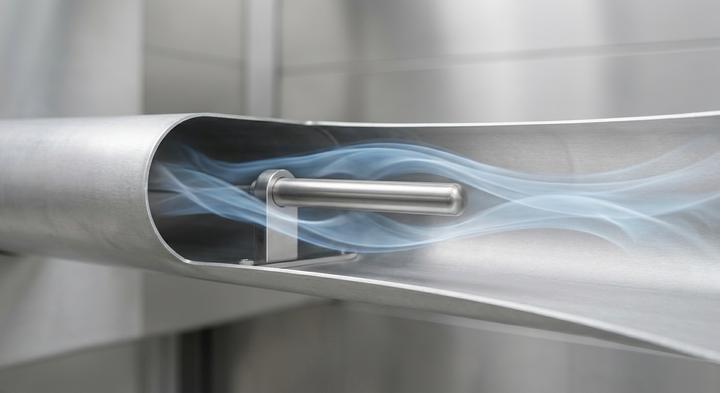
Duct-mounted sensor design optimized for high-velocity commercial airflow environments.
A field tech troubleshooting a newly commissioned building automation loop at 2:00 AM rarely suspects the sensor casing—until a 15 m/s blast of duct air shears off a weak mounting flange, sending condensation directly into an unshielded RJ45 connection. Standard, mass-market thermo-hygrometers designed for clean commercial lobbies or server racks simply aren’t built for high-velocity HVAC ducts. On daisy-chained RS-485 runs spanning three floors, these cheap units lack the optoelectronic isolation needed to survive ground-loop potential offsets. When transient voltage spikes exceed the standard transceiver’s common-mode voltage limits, the device doesn’t just fail; it drops entire sections of the bus, paralyzing the system.
Then there is the integration tax. Many retail sensors ship with hardcoded, fixed Modbus registers. When an integrator realizes they cannot remap the sensor map to match the legacy controller’s inputs, they are stuck writing and maintaining custom translation middleware. That engineering time quickly eats up whatever pennies the purchasing department saved on the unit cost. It is the classic disconnect in commercial HVAC: procurement buys on unit price, while the installer is left fighting cheap terminal blocks that double their hours on the wall. For an HVAC OEM, a sensor is a long-term commitment to system accuracy and custom branding, not a disposable commodity.
This is where direct-to-factory engineering makes the difference. At YGhao, we modify sensor PCB layouts and transceiver components to eliminate signal drift on noisy building buses, replacing thin-walled enclosures with ruggedized, isolated designs. We build these probes with tension-clamp terminals that speed up installation, bridging the gap between the OEM’s need for stable accuracy and the installer’s demand for a tool-free, drop-in fit. The takeaway is simple: if a sensor cannot handle the electrical noise of a shared bus and the physical stress of duct velocity, it is not a bargain—it is an expensive liability.
Engineering Specs for Long-Cable Networks: Modbus RS-485 vs. BACnet MS/TP

Isolated transceiver layouts prevent ground-loop communication failures over long-distance networks.
Which physical layer specifications actually prevent RS-485 thermo-hygrometer failures on cable runs exceeding 100 meters?
Routing standard RS-485 lines across 150 meters of conduit is a gamble with predictable, expensive consequences. Ground loops are inevitable when a cable bridges mechanical zones powered by different electrical sub-panels, driving DC currents through signal lines that destroy the transceiver’s input stage. Adding optoelectronic isolation physically breaks this copper path, blocking transient voltage spikes and ground potential offsets before they can corrupt the data packets.
| Operating Environment | Physical Protocol | Optocoupler Isolation Voltage | Sensor Cap Material | Factory Calibration Standard |
|---|---|---|---|---|
| Velocity Intake (Ducts, 10–15 m/s) | Selectable Modbus / BACnet | 1.5 kV DC | Sintered Stainless Steel | ±1.5% RH, ISO/IEC 17025 |
| Process Cleanrooms (Washdown zones) | Modbus RTU | None (Local short run <10m) | Sintered PE (<10 µm) | ±1.0% RH, NIST Traceable |
| HVAC Retrofits (Noisy commercial loops) | BACnet MS/TP | 2.5 kV DC | Bronze Mesh | ±2.0% RH, Factory Certified |
Selecting Casing and Protocol for Long Cable Networks
In long-run Cable Networks, the physical sensor filter cap determines whether a thermo-hygrometer survives five years or five months in the field. For high-velocity ducts, physical shear stress and dust bombardment degrade unprotected capacitive polymer elements. Sintered Stainless Steel caps provide the highest mechanical protection and resist heavy condensation, though they introduce a slight thermal lag that HVAC programmers must damp. For HVAC retrofits, Bronze Mesh offers fast response in low-dust environments but will corrode if exposed to outdoor intake air. In cleanrooms with chemical washdowns, sintered PE filters (<10 µm) resist aggressive sterilization agents without clogging.
When evaluating the Engineering Specs of a thermo-hygrometer, look closely at the relationship between the physical environment and transceiver limits. Stocking two separate SKUs for every zone is an operations headache. System integrators can avoid this by selecting units that offer Selectable Modbus and BACnet physical layers on a single board. This setup uses custom firmware to toggle between Modbus RTU and BACnet MS/TP without changing physical boards—usually via simple onboard DIP switches. It means you don’t have to explain to a tech on a ladder why they have the wrong board in their hand. When buying these sensors, ensure they are Factory Certified and calibrated to recognized rules like ISO/IEC 17025; uncertified sensors drift past acceptable limits within weeks of commissioning.
Specify 2.5 kV optocoupled isolation on any run over 100 meters, or plan to replace transceiver chips after the first summer storm.
Customizing the Board for the Field: Three Commercial Environments
A calibration tech pulling a validation log at 6:00 AM does not want to see a sudden 8% relative humidity spike in a production suite that must stay bone-dry. When standard thermo-hygrometers face industrial cleaning agents or high-velocity duct moisture, they do not just drift—they fail completely. To keep systems online, custom thermo-hygrometer configurations must be matched to the actual physical stresses of the deployment site rather than the idealized specs on an off-the-shelf datasheet.
Cleanrooms: Surviving Aggressive Sterilization In Regulated Facilities

Specialized sensor housings are engineered to withstand aggressive chemical sterilization in clinical environments.
Maintaining a tight ±1.5% RH window in pharmaceutical suites is impossible if the sensor element is exposed to vaporized hydrogen peroxide (VHP) washdown cycles. Standard polymer capacitive sensors absorb VHP, leading to permanent chemical shifts and premature failure. To combat this, we supply custom configurations at YGhao utilizing specialized, high-porosity PTFE membrane filters and hermetically sealed stainless-steel housing assemblies. We coat the internal boards with military-spec polyurethane conformal protection, preventing corrosive vapors from eating the traces while keeping the high-precision capacitive element shielded. This keeps cleanroom sensors stable through hundreds of aggressive sanitization cycles without requiring constant field recalibration.
Air Intake Ducts: Using Sintered Caps To Prevent Drift In Saturated Environments In Commercial HVAC
In wet Air Intake Ducts, high air velocity combined with incoming outdoor humidity creates a continuous misting effect that easily chokes standard sensors. When water droplets settle directly on a standard sensor element, the reading flatlines at 100% RH and stays there until the physical substrate dries out, which can take hours or days. The solution requires using heavy-duty Sintered Caps made of porous stainless steel to deflect direct water droplets, coupled with an active heated sensor element. The internal heating circuitry periodically raises the temperature of the sensor substrate just slightly above the ambient dew point to burn off micro-condensation without distorting the overall HVAC temperature log. This active condensation management ensures that the system continues tracking true environmental conditions through heavy storms and seasonal fog.
Office Retrofits: Fast Installation When Budgets Are Tight
The Cost of Poor Integration: Where RS-485 Deployments Break Down
Ground loops and rigid register maps ruin more field commissioning deadlines than physical hardware defects ever will. When a commercial HVAC installation spans multiple mechanical zones, assuming basic physical and protocol compatibility is the fastest path to expensive troubleshooting hours and blown transceiver budgets.
“RS-485 is a simple two-wire network that does not require a shared third-wire ground reference.”
Ignoring ground voltage differentials between separate air handlers is a fast way to fry transceiver chips during commissioning. When separate air handling units run on different electrical phases, the local ground potential shift easily exceeds the standard ±7V common-mode limit of standard RS-485 transceivers. When unisolated RS-485 deployments break down, ground loop currents can instantly destroy the board. System designers must specify three-conductor cabling or select isolated transceivers. Suppliers like YGhao resolve this at the board level by offering 2.5 kV optocoupled isolation as an OEM upgrade, protecting the thermo-hygrometer from high-voltage transients on the shared bus.
“Any Modbus RTU thermo-hygrometer will drop straight into our legacy building automation profiles without reprogramming.”
Accepting hardcoded register maps requires software engineers to manually map addresses instead of dropping them into existing setups. Instead of wasting engineering hours writing custom scaling blocks in the controller, procurement should partner with a factory that can pre-flash the thermo-hygrometer controllers with custom register maps before delivery. Pre-mapped registers eliminate field addressing errors and speed up network commissioning.
“Assuming clean outdoor air means zero drift, ignoring how VOCs and plastic outgassing degrade bare humidity elements over time.”
While visible dust is easy to spot, chemical outgassing from duct adhesives, volatile organic compounds, and outdoor pollutants degrade bare capacitive elements within months. These corrosive agents chemically blind the sensor substrate, causing a gradual calibration drift that goes unnoticed until building performance suffers. Specifying a rugged sintered porous metal filter protects the thermo-hygrometer element from microscopic degradation while maintaining rapid response times.
When comparing thermo-hygrometer quotes, the cheapest unit usually becomes the most expensive the moment a technician has to spend three days in a scissor lift tracing a ground loop.
Auditing Your Sensor Manufacturer: Red Flags and Factory Capabilities
Securing an RS-485 line with 2.5 kV optocoupled isolation only works if the board is actually assembled under tight QC, rather than hand-soldered in an ungrounded workshop. Evaluating these factory capabilities while walking the line will quickly show if a vendor is a true OEM partner or just a middleman boxing up generic boards.
Technical Audit Criteria
| Audit Point | Acceptable Factory Proof | Sourcing Red Flags | Internal Technical Sign-off |
|---|---|---|---|
| SMT Line & ESD Control | Real-time ESD wrist-strap monitoring systems at all assembly benches; 100% Automated Optical Inspection (AOI) on all PCBs directly after reflow soldering to catch solder bridge defects, tombstoning, and micro-cracks. | Relying on manual optical check methods; ground straps not actively logged or tested daily; high reflow oven temperature variance. | Hardware Engineering Lead |
| Thermo-hygrometer Calibration | Multi-point automated reference chambers running controlled humidity/temperature sweeps (e.g., 10%, 50%, 90% RH steps); live serial data logging of calibration curves, standardizing on YGhao’s direct calibration documentation process. | Batch-testing against a single room-temperature wall unit or handheld meter without isolated environmental control or multi-point automated reference chambers. | Quality Control Director |
| Compliance Verification | In-house pre-compliance test laboratory equipped for CE, FCC, and BACnet BTL physical layer parameters to verify RS-485 transceiver signal integrity under simulated noise. | Reliance on external laboratories without preliminary verification capabilities, which frequently causes costly redesign cycles and laboratory testing delays. | Lead Compliance Engineer |
| Traceability & Auditing | Complete barcode or QR code tracking for each printed circuit board assembly (PCBA) linked to component batch codes (e.g., specific sensing element batches), ensuring rapid containment of component anomalies. | Paper-based traveler sheets with missing component batch associations; failure to separate failed units in locked, designated scrap bins. | Supply Chain Director |
Skipping these factory checks is how you end up with infant mortality failures in the field that are nearly impossible to trace once the sensors are sealed behind HVAC access panels. In contrast, clean, automated calibration documentation protects you from the finger-pointing that happens when a BMS commissioning agent flags a 5% RH variance on-site. At YGhao, we structure our production floor specifically around automated calibration sweeps and live serial logging, so you get verifiable proof of performance long before the units arrive at your warehouse. Our next phase breaks down the actual commercial mechanics of ordering these units, focusing on minimum order quantities, lead times, and custom packaging workflows.
Moving from CAD and Spec Sheets to Production-Ready Samples
With isolation barriers specified and calibration protocols locked down, the practical hurdle is turning those electronic layouts and Spec Sheets into physical, mountable hardware without losing weeks to tooling delays. In building automation, deployment schedules rarely die from a single, catastrophic design failure. Instead, they are choked out by minor, compounded timeline slips during the tooling and board-spin phases—like waiting four weeks for a plastic housing modification just to find the terminal block hits a structural bracket. To bypass this, the engineering sequence must run in parallel. Prototype design boards can be populated and shipped in 15 days, allowing developers to execute electrical validation and firmware sweeps on the bench while the steel tooling is being cut. For custom plastic injection tooling adjustments—such as modifying duct-mounting flanges or altering probe lengths to match specific air-handler profiles—tool modifications require 30 days. On the commercial side, keeping unit economics viable means our minimum order quantity (MOQ) for custom-molded enclosures is 1,000 units. However, if the standard housing works and only the internal PCB layout needs a tweak—like relocating terminal blocks or adding transient-voltage protection—the MOQ drops to 500 units.